


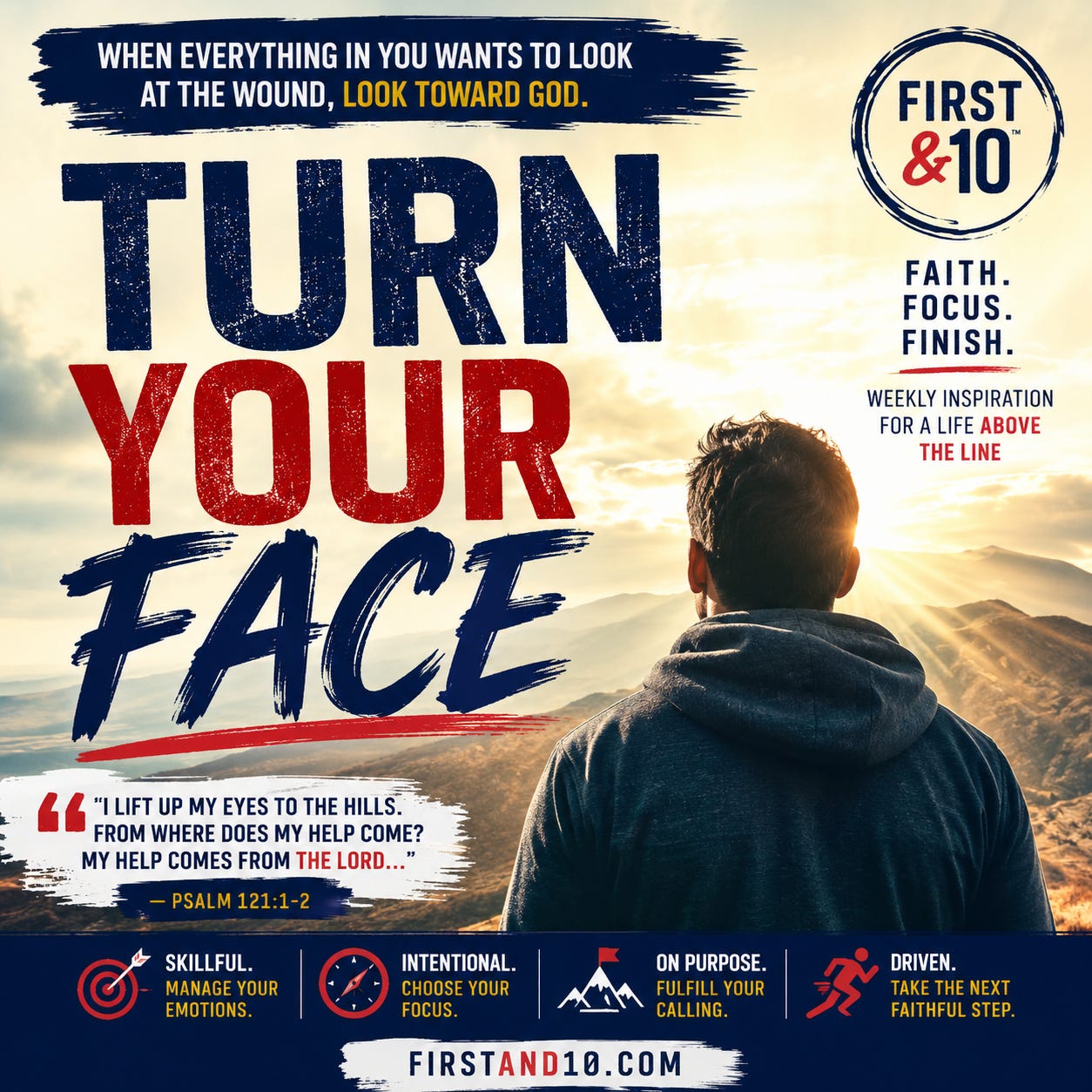
When everything in you wants to look at the wound, purposely look toward God instead.
“I lift up my eyes to the hills. From where does my help come? My help comes from the LORD, who made heaven and earth.”
—Psalm 121:1–2
“The LORD is near to the brokenhearted and saves the crushed in spirit.”
—Psalm 34:18
“Your word is a lamp to my feet and a light to my path.”
—Psalm 119:105
There are mornings when something has hurt so deeply, angered us so completely, that prayer feels almost impossible.
We know what we want to say. We know what we want to do. We know precisely where we want to point the finger.
We replay the conversations. We rehearse the arguments. We remember what was said, what was done, what should have happened, what never should have happened.
We stare at the wound. And stare. And stare. Until somewhere beneath all that noise comes a quieter question:
Where are our eyes?
Ouch. Because sometimes the hardest thing God asks us to do isn’t to understand what happened. It isn’t even to forgive what happened. Sometimes the first thing He asks us to do is simply this:
Turn your face.
Let’s Look at the Wound
Pain has an extraordinary ability to command our attention.
When someone hurts us, disappoints us, betrays us, lies to us, abandons us, misunderstands us, or treats us unjustly, our minds naturally return to the scene of the injury.
Why? How? What were they thinking? What should we have said? What should we do now?
And some wounds genuinely require action. There may be truth that needs to be spoken, boundaries that need to be established, wise counsel that needs to be sought. There may even be wrongs that need to be confronted.
Christian faith does not require us to pretend evil is good. Forgiveness does not require foolishness. Grace does not require silence. And surrender does not mean passivity.
But there is a dangerous point at which something can move from requiring our attention to demanding our occupation.
It moves into our thoughts, our conversations, our sleep, our prayers, our peace. Eventually, we discover that we are no longer merely dealing with the wound.
We are staring at it. And staring at a wound will not let it heal.
Lift Our Eyes
Psalm 121 begins with an extraordinary decision: “I lift up my eyes...”
Notice what the Psalmist does not say. He doesn’t say there are no mountains. He doesn’t say there is no danger. He doesn’t say everything is fair. He doesn’t say everything has been resolved.
He simply decides where he is going to look: “I lift up my eyes to the hills. From where does my help come?”
And then comes the answer: “My help comes from the LORD.”
There it is.
Not from winning the argument. Not from finally being understood. Not from someone apologizing. Not from proving we were right. Not from controlling the outcome.
From the Lord.
There are moments when we become so consumed by what people have done that God quietly asks us, “Where are your eyes?”
And sometimes the answer is uncomfortable. Because we have our eyes on ‘them.’ On what they did. On what they said. On what they took. On what isn’t fair. On what we wish we could change.
And yet God keeps whispering, ‘Look at Me.’ That is not denial. It is reorientation.
The wound can still be real. The injustice can still matter. The consequences can still require wisdom. But none of those things gets to occupy the throne. Because what hurt us may deserve our attention.
It does not deserve our worship.
Turn Your Face
Maybe that’s why Psalm 34:18 feels so different when we’re actually hurting. Read it slowly, aloud. Let it splash across you, like laying on a beach at the tip of the tide, cool water washing across your skin.
“The LORD is near to the brokenhearted and saves the crushed in spirit.”
Thank you Jesus that God does not require us to become unbroken before approaching Him. He comes near because we are brokenhearted.
We don’t have to sanitize the prayer. We can say: “God, we’re angry. God, we’re hurt. God, we don’t understand. God, we want to forgive, but we’re struggling. God, we know we’re supposed to trust You, but right now we don’t know how.”
Those aren’t necessarily faithless prayers. Sometimes they are the beginning of faith.
David cried out. Jeremiah cried out. Job cried out. Jesus wept. Scripture is full of people who discovered that faith does not require pretending pain doesn’t hurt.
God is not intimidated by our tears. He doesn’t stand across the room waiting for us to compose ourselves.
He draws near.
Think about a child who falls and runs toward a parent with scraped knees, tears streaming, words barely understandable between sobs.
A loving parent doesn’t say, “Come back when you’ve stopped crying.”
Arms open. The child runs. And sometimes that is prayer.
Not an explanation. Not a theological dissertation. Not a beautifully constructed sentence. It’s OK for us to be just a broken child, turning toward our Father.
Turn your face.
Take the Next Step
But what happens when we turn toward God and still don’t have the answer? We take the next step. One of the great frustrations of faith is that we often want God to illuminate the entire road.
God, show us how this ends. Show us what happens next month. Show us why You allowed this. Show us how You’re going to fix it. Show us that everything is going to be okay.
And sometimes God gives us something much smaller. A lamp. “Your word is a lamp to my feet and a light to my path.”
A lamp doesn’t illuminate the entire horizon. It illuminates the ground immediately in front of us. Enough light for one step.
Then another. And another.
Maybe today we don’t need enough strength for the next 10 years. Maybe we don’t even need enough strength for tomorrow. Maybe we need enough grace for this morning.
God, what belongs to us today? What do we need to release? What truth do we need to remember? What conversation should we have? What conversation should we not have? Where do we need wise counsel? Where do we need restraint? Where do we need courage? Where do we simply need to be still?
Sometimes the most faithful prayer we can offer is the simplest prayer.
“Lord, we cannot carry the whole mountain today. Just show us where to put our foot next.”
Above the Line
This is where our Above the Line principles stop being motivational language and become spiritual practice.
Skillful. Pain makes us reactive. Skillfulness means refusing to let the wound choose our response. We can feel deeply without surrendering control of our words, decisions, or actions.
Intentional. We cannot always choose what happened to us, but we can choose where we continually direct our attention. Prayer over rumination. Truth over assumption. Wisdom over impulse. God over the wound.
On Purpose. Someone else’s failure does not cancel God’s calling on our lives. Our pain may become part of our story, but it does not get to become the author. We are still called to love, still called to serve, still called to build, still called to lead, still called to become who God created us to be.
Driven. Being driven doesn’t mean pretending we’re fine. Sometimes it means taking a bold leap. Sometimes it means getting out of bed. Sometimes it means making the difficult phone call. And sometimes it means having enough discipline not to make one. Faithful persistence doesn’t always roar. Sometimes it whispers.
One more step. And the truth we may not want to hear sometimes?
Our pain deserves compassion, but it does not deserve control of our future.
We can honor what happened without surrendering who we are becoming. We can grieve what was lost without forfeiting what remains. We can acknowledge anger without allowing anger to become our identity.
And we can seek justice without surrendering our hearts to revenge.
Regain Your ‘Remain’
Maybe faith today isn’t rising triumphantly above everything that hurt us. Maybe it isn’t waking up tomorrow suddenly healed, smiling, victorious, with every question answered.
Maybe faith is quieter than that.
Maybe faith is remaining. Remain with God when we’re furious. Remain faithful when we’re wounded. Remain tender when becoming hard would feel safer. Remain obedient when retaliation would feel delicious.
Remain in the arms of Jesus. Remain ALL His.
On those days, in those moments, when we’re sobbing before God and don’t even know what to say, simply start right there. Tell God, “Lord, I’m here! I’m yours! Unwavering! Lord, I remain!”
How cool is it that we don’t have to manufacture a spiritual experience. We don’t have to perform strength. We don’t have to pretend the tears aren’t there.
Let them come. Bring the questions. Bring the anger. Bring the disappointment. Bring the confusion. Bring the wound.
But underneath it all, make one decision:
Turn your face. Because our broken hearts are not proof that God has left. The chapter we’re living is not the whole book. The people who hurt us do not get to write the ending.
The wound does not get the final word.
And maybe today we don’t need to know how the story ends. Maybe we simply need to lift our eyes, turn our tear-streaked faces toward Heaven, and with whatever energy we can muster, whisper to our Father.
“Thank you, Jesus! By your stripes, we are healed! With your strength, we’re still here!”
Then listen for that still, small voice. Because somewhere beneath all the noise comes the same answer that has shaken hell and reshaped the entire universe.
“So am I.”
Let’s Pray!
“Father, we come to You exactly as we are today. Angry. Hurting. Confused. Exhausted. Maybe even in tears. We don’t have the strength to carry everything we’ve been carrying, and today we finally admit that we were never supposed to. So we give it to You. Meet us in the places we cannot explain. Heal what we cannot repair. Give us wisdom for what we must confront, grace for what we must forgive, courage for what we must do, and restraint for what we must leave alone.
“When our eyes drift back toward the wound, turn our faces toward You. Teach us to live skillfully so pain does not control our response. Make us intentional about what occupies our minds and hearts. Remind us that we are still here on purpose and that someone else’s failure cannot cancel Your calling. Give us the drive to take the next faithful step, even when we cannot see the whole road.
“Protect our hearts from bitterness. Protect our mouths from anger. Protect our decisions from revenge. And protect our spirit from becoming hard. We don’t need to see the entire road today. Just give us enough light for the next step. We give You this moment. We give You this day. We give You the wound. And Father, once again, we give You our hearts.
“In Jesus’ name, Amen.” 💙🙏🏼
Amen! Thank you Coach for Scriptural wisdom, truly you are God's chosen vessel! 🙏❤️
Amen 🙏